Wednesday, October 20, 2021

Pak Zubir Said and Majulah Singapura

Pak Zubir Said and Majulah Singapura

The National Anthem of Singapore

"It is not a film song. It is not a romantic song……It is a special kind of song….I had to consider the content of the lyrics. It should be in simple language, easy enough to sing and easy enough to understand by all races……know the policy of the government, the social life in Singapore and the wish of the people and how to progress to prosperity.                                                                      Zubir Said quoted His Songs published in 1990 by The Singapore Cultural Foundation. 


        This statement is not just the ethos for a nation's anthem but a formula for musical creativity and inclusivity of musical cultures within any independent nation. A nation coming out of more than a century of colonialism and trying to unify itself within a diverse tapestry of cultural, political, historical and social identities. 

        The story of Singapore's national anthem is one that resulted from collective action based on one man's creative energy and professional sincerity. When Zubir Said wrote Majulah Singapura he was not a citizen of Singapore. He was rising in the world of film music and was already acknowledged as a song writer. Underlying all this, he had no formal musical training, in the Wesrern sense of the word music. However, he was steeped in Minangkabao musical idioms and self-added what hee needed for his work in community and film work. He was a self-made entity that grew from conviction, resolute purpose to the point of breaking traditional ties with his father in his earlier years. Pak Said heard a call that transcended his Minangkabao homeland in Sumatra. He followed the path of the perineal itinerant musicians who flowed with the developments of the early 20th century along the Asian Sea Trade Route. Singapore was an important part of that trade route and it was also a special attraction for such musicians like him.

(I will be writing two more blogs on the music of Zubir Said to talk about his songs and his music for films)


The First Version of the Singapore Anthem

Majulah Singapura was first written in 1958 for the re-opening of Victoria Theatre after it went though upgrading. Then when Singapore obtained self-government in 1959 it was refined again and made the country's national anthem. This was how it looked in cipta notation in 1959 - the notation of the solmisasi system in music in most of Asia at that time.

There were floppy single based vinyl recordings of that first version using R.M.P 331/3. These old floppies were usually testing single recordings on the market before they were pressed into vinyl records. I suppose some copies were made for the event in 1959. I happened to know someone who had that but who did not want to part with the recording. But I was allowed to make a copy.


The Early Majulah Singapura Recordings
http://youtu.be/GtrZUMrXXS4


Timeline Music Annotation is a new way of writing text and manipulating graphics to sound. I use this in my teaching and archiving. To know more, see the my earlier blog entry:http://thesonicenvironment.blogspot.sg/2014/06/tmal-timeline-music-annotation-library.html

The Annotated Line Score of the Original Majulah Singapura

When the anthem for Singapore as a Republic was established, Majulah Singapura went though a review which finally ended up in eight bars being removed. Musically that was a good move. Culturally, those eight bars also contained musical motifs that leaned on Malay music fundamentals - I explain this in the short video that follow the score below:

Video Excerpts on the removal of the 8 bars

Dr Joe Peters Comments on Singapore National Anthem:
https://www.youtube.com/watch?v=Zush_LTX7cg&t=17s


The Line Score of the National Anthem of Singapore

This line score is a staff notation version of the cipta notation above. It has been annotated to show the 8 bars that were removed.


Many Versions of Majulah Singapura

There were many different musical groups that performed this Singapore Nationa Anthem. Here are 10 such versions complied into a Timeline Music Annotation format and made into a video. In this format text and graphics can be used to make notes and explanations directly to the sound timeline of any piece opt music. To learn more, refer to the earlier blog on TMAL at this sonic environment blog. TMAL is a music education project of Sonic Asia Music Consultants in Singapore. Currently, a server based operation is being tested. 

http://youtu.be/VIxgy81T0Ek


      If you have made versions of the Singapore Anthem, please share them with me as I would like to make a study of musical aspirations in our anthem and any mileage it makes in music in general. There have been calls for change or re-arrangements of the anthem. I have always stood for no change in the anthem - but we can do with different arrangements. You can contact me at the following sites:
Email: sonicasia@singnet.com.sg
Facebook: https://www.facebook.com/sonicasia
Or at this blog right here.


Thursday, May 21, 2015

Freddie Aguilar in Singapore

Anak - The Untold Story: Illustrated Lecture at the Singapore Management University under the Lien Fung's Colloquim!


 Freddie Aguilar with his Taylor Guitar                                                                                                                                                                                        

                                                                                                                                 
Kirpal Singh and I met Freddie at his new club Ka Freddie at Quezon City to convince him to come to Singapore and talk about the many untold details of his illustrious music career.


Anak is still the single most successful Asian song that went viral in 1978 and maintained its place till now. You can hear the original version here:

https://www.youtube.com/watch?v=-n-2lPzH7Do

Many versions came about since then. In Singapore, Ramli Sarip did a Malay version:

https://www.youtube.com/watch?v=9BrUlVv-IsI

I met Freddie in 1978 while I was studying at the College of Music, University of the Philippines. My trio played in his club Bodega. 


Joe Peters and his East West Trio in Quezon City in 1978


 Freddie Aguilar, the extraordinary Filipino musician who created the song Anak, a timeless folk song that sustained as an international hit since 1978, gave his illustrated talk on Anak- The Untold Story. on 18 April 2015 at SMU. Freddie charmed the audience with his humour. With his Taylor guitar strapped to his body, as he told his story to an attentive and responsive audience. He ended his talk with a performance of Anak, accompanied by his son Jeriko and the Singapore Tremolo Rondalla. There are 15 segments (on UTube) that covers the entire talk and performance. Anak is still a good music business model for your professional musicians who are trying to make their way in the industry.
If you are in Manila and want to say hello to Freddie and his son Jeriko, you can visit Ka Freddie Restruant and Bar, where Freddie performs. He has other musicians there too - it like a re-creation of his old University Belt club BODEGA - some forty years ago. Ka Freddie is at 120 Tomas Morato Avenue, Quezon City. 


THE VIDEO CLIPS

1 Freddie Aguilar's Talk at SMU: Early Life at Isabela LRe

2 Freddie Aguilar's Talk at SMU: Growing Up in Manila

3 Freddie Aguilar's Talk at SMU: Leaving Home

4 Freddie Aguilar Talk at SMU: Trying to Make It in Manila

5 Freddie Aguilar's Talk at SMU: Olongapo City

6 Freddie Aguilar's Talk at SMU: Olongapo City Making it Finally!

7 Freddie Aguilar's Talk at SMU: Olongapo The Making of Anak

8 Freddie Aguilar's Talk at SMU: Anak Brings Father and Son Together LRes

9 Freddie Aguilar's Talk at SMU: 1st Metro Manila Music Festival

10 Freddie Aguilar's Talk at SMU: Loosing and Winning

11 Freddie Aguilar's Talk at SMU: Performance Preamble

12 Freddie Aguilar's Talk at SMU: Performance of Anak

13 Freddie Aguilar's Talk at SMU: Truth about the English version of Anak

14 Freddie Aguilar's Talk at SMU: MABUHAY Performed by Singapore Tremolo Rondalla

15 Freddie Aguilar's Talk at SMU: Question and Answer Session


Sunday, September 14, 2014

LORD OF THE RINGS - Performance and Study of the Score

Johan De Meij
In the 1980s I met Johan De Meij (https://www.facebook.com/johan.a.demeij?fref=ts), then an up and coming symphonic band composer and conductor, on one of my visits to WASBE (World Association of Symphonic Bands and Ensembles). He was riding high because of an exceptional music work for band: LORD of the RINGS! It won the top award in 1989 for the Sudler International Prize for Wind Bands and was published by Amstel.
The Amstel Publication of the Score

The First Movement "Gandalf" opening page of the score
I was then encouraging the NUS (National University of Singapore) Symphonic Band to play these types of works in the band literature in their Intempo concert series. They did  that in 1992 and the performance was audio recorded by the EML (Electronic Music Lab). This work was a challenge for the NUS Band because they never performed such a long work that covered the entire first half of the concert.
EML Recording Jacket

Programme Notes
NUS Symphonic Band conducted by Joe Peters

Johan is today a role model for band conductors, entrepreneurs and developers all rolled into one. If you follow his Facebook page, he is still active and central to the high quality in the performances and score publication of European band music. As a tribute to him, I like to present that performance of the work LORD of the RINGs according to the score that was published by Amstel (see above).

Go to this site to listen to the performance of Lord of the Rings By Johan De Meij by the NUS Symphonic Band:

http://www.youtube.com/watch?v=FHE-D5XhKkM&feature=em-upload_owner

Lord of the Rings and Timeline Music Commentary at SMU (Singapore Management University)

Between 2000 - 2007 I taught a music elective at the newly established SMU - Music East and West. I had a chance to test some of my music pedagogy ideas within a music laboratory that focused on students deconstructing music works like the Lord of the Rings and doing objective lay-persons commentary directly to the music timeline. Back then much technology had to be configured to enable this. A team of students took up the challenge to do their analysis and timeline music commentary on Johan Di Meij's Lord of the Rings.


Timeline Music Commentary is part of a pedagogy I pursued since the early 1980s because I thought that text, graphics and audio commentary had a role to play in conveying information (by experts or ordinary people) directly at the timeline of the sound. Much of this consolidated during the period I taught at SMU because I was able to build a laboratory to enable this. Today there is TMAL which is software based - refer to my blog article "Timeline Music Annotation Library: 


The SMU students who did this timeline music commentary put in tremendous effort in learning the concepts and techniques of data gathering using the study tracks technology, the sonic orders listening technique and understanding audio editing and studio operations. This is their work which served as their term paper:

Go to this site to listen to the SMU Student's Timeline Music Commentary on LORD of the RINGS:


Saturday, August 10, 2013

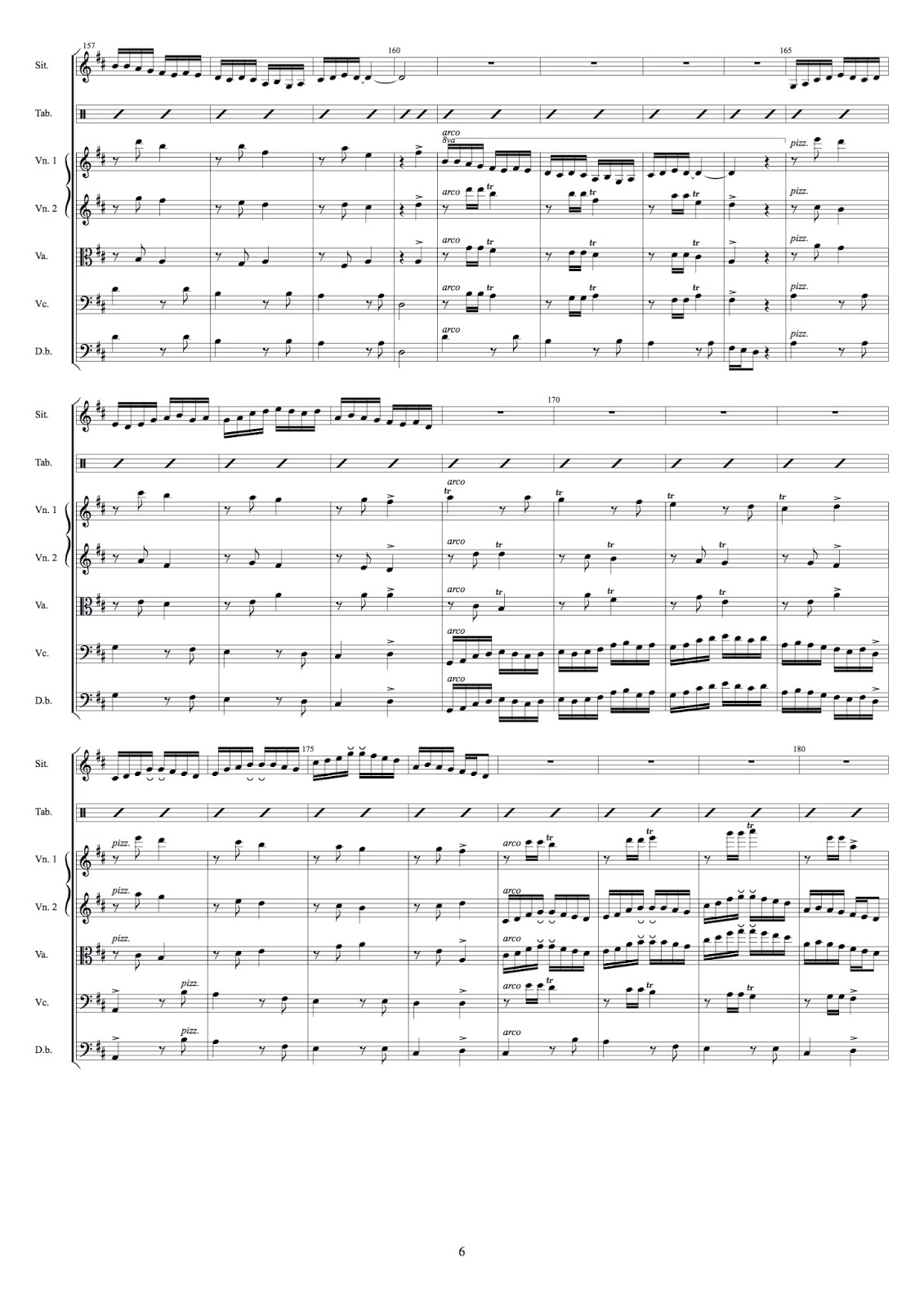
Desh Raga for Sitar and Tabla with Western String Orchestra


Title of Work: "Desh" for Sitar, Tabla and String Orchestra Composer: Dr. Joe Peters
Solo Performers: M S Maniam (Tabla) and S Anbarasan (Sitar) Duration: 15 minutes
(Performed by the New Music Forum in SIngapore in 1987)

A second performance was done in 2006 by the Vietnam Symphony Orchestra in Hue City. Lazar Sebastian played the Indian violin. M. S. Maniam played tabla again.

See below for an audio recording of the work:
http://youtu.be/n8PnxdIgntw


This work is dedicated to Ustad Zia Ul Hassan who was my sitar teacher as well as teacher and mentor to the two performers: M. S. Maniam and S. Anbarasan. Ustad Zia resided in Singapore between 1972-1984 during which he performed widely. He died in India in 1986, but he left the strong musicality of the Vilayat Khan school of Indian music performance among many of his students. 

"Desh" is one of the 16 ragas under the Asawari Thata (North Indian Music) and is sometimes referred to as "Desi." The third and the sixth of its scale are omitted in ascent. In descent, these notes are included, but their approach has a specific routine from the note below, and which gives the raga its special aesthetic. Likewise, the approach to the tonic on descent is always preceded by the major seventh. However, it is also important to understand that these theoretical descriptions are done in terms of Western music, and would be an approximation to the real truth. Unfortunately, there is no other way of describing "Desh" to a lay Indian music audience, but one that may be steeped in the understanding of other musics.


This is a morning raga, mystic in character and pinned on heavy melodies. The work is in one movement and done in quasi concertino style. The Contra Basses and Cellos open the work in the Western tonality of D minor and establishes the alap. It is then developed by the sitarist accompanied by muted strings, simulating the characteristic drone in Indian music, that usually accompanies an opening alap. A short interlude follows introducing the tabla, after which the sitar and tabla, and the orchestra, take turns to lead each other into a developmental middle section that has a lively melody moving between 2/4 and 6/8 meters. There is no change in key as in Indian music, pitch changes require a change of instrument. Rather it is thematic changes than matter. 


The middle section ends with a tutti for orchestra and here there is a pitch change to A major in the style of Western music. At the end of this tutti, Maniam performs his characteristic tabla style with some sequences (e.g., glissandi on the tabla) for which he is well known. 

(The sitarist may join in the improvisation, if the musicians feel that is appropriate — in true style of an Indian music performance.) 

If such East-West scores are used more regularly by Western orchestras then a true culture of East-West musical concepts and skills can be shared and developed into a new performance practice.


After the cadenza there is a re-capitulation of the alap — this time with a solo violin (leader of the orchestra) playing, while the sitarist improvises around the raga. The violinist is also encouraged to improvise in tandem with the sitarist. In this recording this did not happen. Likewise the sitarist, in this recording, did not do any extended improvisation. 

The score was read as it was written. The original intention was to make this the very heart of the East-West dialogue. 


The finale follows and it is again in a dialogue form between the tabla, sitar and orchestra. The tempo is presto and the music is vigorous and forward moving. The ending Coda is in full tutti and it is based on a basic ending formula used in many ragas, including Desh.

The raga-tala formula which is the tag name for the Indian musical system, has been used in may East-West compositions. There is enormous room for growth of musical expression by conducting musical dialogue though deep learning of musical systems. The tendency today seems to be to take frills from such diverse musical systems and add them to very simple Western based music. There is no objection to this, but concerted work in this direction can only lead to the total levelling down of musical expression in the world. 


This work was written as a culmination of my early work on the study of East-West musical phenomenon. I was exposed to a number of such formulae at the University of the Philippines where I studied for a Masters in Music (1978-1981). From 1982, my friends and I formed the Folk Jazz Ensemble which explored fusion between Indian and Western musical systems. Oh particular importance to me was how we could make such dialogue equitable. Our discovery was that we could make the soundscape change with dialogue on the elements of timbre, form, rhythm and to some extent aesthetics. But we could not perform equitably in the area of pitch. It required deep and long bi-musical training, in this case.


These men in the Folk Jazz Ensemble were exceptional people, talented to the core and friendly to the end of the earth. They were Alex Abisheganaden (guitar), Zia Ul Hassan (sitar), MS Maniam (tabla), and Joe Peters (Double Bass). When Zia returned to India in 1984, his students S. Anbarasan took his place. Jibby Jacob (violin) joined us in the 90s. Victor Savage (vocal) is the latest member of the group. You can see some clips of this group in the video.


Ustad Zia for whose memory I wrote this work was an enigma. His story will take another blog in the neat future. His contributions to the foundation of Indian music studies in Singapore was immense and unknown because his cause in life was music and he kept that private and very personal. 

He came from the Viliat Khan school of sitar music and styles. Desh Raga was one his favourites and I followed his trend of musical thought on this Raga for some years. 


My quest is to understand musical trajectories and how such trajectories affect growth, change, and the rise and decline of musical systems and cultures. All branches of music are important for such a study. My unusual musical career began very young and was totally applied and investigative from the age of twelve. So this subject of musical fusion and musical trajectories was a magnet for me. The 1980s was a decade of fusion exposure for me with the various ASEAN projects I was involved in, the international discourse on this subject, and the Folk Jazz Ensemble as a personal laboratory.


Finally, I must confess that  Desh Raga for Sitar, Table and Western String Orchestra was written to test the Western trained orchestral musicians in a dialogue with Indian trained musicians to see if they could "pitch migrate" as well as the Indian musician. Sadly, I must say that they have failed and badly. It is not their fault. It is the conservatories that have failed them. The challenge for the 21st century for  any music conservatory to develop and succeed in a pedagogy that can create skilled bi-musicality or even tri-musicality in their wards.


Both performances (in Singapore and Vietnam) showed that the Western musician is intransigent to the principles that he/she was taught, particularly the conductors, and so the Indian musics make the compromise and adapt. The hard fact is that the Indian musician is trained much better for pitch flexibility and therefore has something to offer to Western conservatories in terms of bi-musicality or even tri-musicality principles.


The video that accompanies this article is for the purpose of listening to the music. The full conductor's score is in this article (as you can see). If you want to perform this work, let me know and I will send you the parts. 

The audio in the video is the recording done in 1987 in Singapore of the New Music Forum Orchestra conducted by Lim Yau. However, I do not have pictures or video of that concert. So the pictures and videos that are in this version are those of the performance in Vietnam in 2006. They are there for information and are not in sync with the audio. There are also video scenes of the performers in both concerts. In Vietnam, because Anbarasan was not able to go, Lazer Sebastian, a local Indian music guru, played the violin.


Friday, April 19, 2013

A Tribute to the late Mr. K.P. Bhaskar


This was a man who had an unspoken vision for relevance and sustainability of the traditional arts in Singapore. And in doing this he saw the richness of the bestowed cultural heritage of Singapore, linking us directly to the great centres of civilization and culture spanning Asia and the world. Nobody in the right frame of mind and at the incubating juncture of Singapore itself would ever dare to breathe out aloud such a vision. Words alone would not be that magic wand to making real such a vision. He like Brother McNally who founded Lasalle College for the Arts and my teacher Professor Jose Maceda at the University of the Philippines, all gone now, but they have left a beacon light for others to carry on.


Mr. Bhaskar was a good friend to me. We came from the same community but we are poles apart. He never once referred to any difference between us. It is the way of the pioneering Singaporean – one who came from a foreign land and saw great potential for this island to play a rightful role bridging so many gaps in modern times - cultures, languages, points of view and priorities.

He liked to talk and we did talk much at unplanned meetings, sometimes at concerts, while waiting at rehearsal sites and even at supermarkets. His engaging ways makes any age difference diluted. In fact I can say I have learned much from him on this front because now the gap between my current students and myself is much more that it ever was between Mr. Bhaskar and me.

Like Bro. McNally and Prof. Maceda, he laid the foundation for others. Mr. Bhaskar founded not one, but two successful and inter-related arts institutions: The Bhaskar’s Arts Academy and the Nrityalaya Aesthetics Association, blending beautifully the two interrelated components of Indian music and dance arts.

He was a great believer in education - always ready to participate in anything that would help the progress of new knowledge. This is where I will tell you of his special help to me when I designed a new timeline music annotation laboratory at the Singapore Management University where I taught the Music East and West elective between 2000-2007. I needed challenging local traditional repertoire for my students to apply the musical deconstruction technique they were taught. He staged a special performance of Kuchipudi and Kathakali, which he pioneered in Singapore. He patiently followed all the laboratory operations including a live commentary over an in-ear wireless system to my students. All this was new and foreign to him. Yes he went out of his way to do what was required. The result surprised me when the students came up with their very well done deconstruction presentations on the music – music totally new to them. Three examples are shown below as well as a short video showing the excerpts of the opening and end of the performance and some concluding comments he made.


That fledgling effort has now grown into a major teaching exercise I am doing in the Mekong Basin known as Timeline Music Education - with dedicated software and AV-IT systems configurations - developing graduate students in the art and science of musical deconstruction across cultures and systems. I owe Mr. Bhaskar much for his trust in what I was then trying to think my way through.

May you rest in peace Mr. Bhaskar and sing and dance beautifully forever in the presence of God.

Tuesday, July 31, 2012

Kim Rockell on Rondalla

Kim Rockell and Joe Peters

Joe Peters and his TREMOLO WALL

Kim Rockell delivering his paper in Tagum, Mindanao, Philippines during the 3rd International Rondalla Festival

Kim Rockell is a PhD student at the University of Cantebury in Christchurch, New Zealand. His dissertation is on rondalla in the Australian diaspora. With a grant from the New Zealand Foundataion,  Kim was able to do research trips to Singapore, Taiwan and the Philippines. An excerpt of his report in NZASIA Newsletter is quoted here for the benefit of rondalla musicians in the Asian region.

Kim Rockell writes:
Fieldwork commenced in December, 2010 with a trip to Singapore. Here it was possible to observe the operation of the “quadrant” concept of Singaporean multiculturalism, and the position of migrant workers from regional, developing countries within this model. The researcher was also prompted to reflect on the geographical position of Singapore within the expansive, Malay world. In terms of the arts, it became clear that the Singaporean government is currently committed to developing arts and arts education. This is, in part, in response to the perceived criticism of a lack of creative thinking in Singapore-educated population.
The highlight of time spent in Singapore was meeting ethnomusicologist Dr Joseph Peters. Dr Peters not only developed the first rondalla in Singapore, but also the first brass band. His current rondalla, which is based at the University of Singapore and predominantly made up of students from mainland China, performed at the 2011 International Rondalla Festival. In addition to his important work on rondalla, which he is currently developing into a kind of pan-Asian tremolo orchestra for the performance of Western music, Dr Peters is now mainly concerned with the preservation of Southeast Asian sound systems. These musical systems, which he refers to as “sonic orders”, are under attack from the dominance of Western tonal systems. Peters has developed a system for measuring global, sonic emissions. He estimates that in most parts of the world today more than ninety percent of musical, sonic emissions are based on a western system. Just as introduced species can cause environmental damage and threaten local wildlife, instruments introduced from Europe such as the piano and guitar, have destroyed much of the fragile, Asia-Pacific, musical landscape. Paradoxically, the piano may also hold the key to aiding preservation. Peters drew the researcher’s attention to the recently developed “fluid-piano” which can be re-tuned, even during performance, to a variety of intervals and scale systems.
Dr Peter’s current work with rondalla is centred on improving instrument quality and he has developed several new proto-types. The tremolo orchestra he is developing will also include seats for pipa, sitar and gambus representing the Chinese, Indian and Malay worlds respectively.
During the researcher’s time in Singapore, Dr Peters was extremely generous with his time. The researcher was able to conduct interviews, photograph Dr Peter’s instrument collection and attend a rondalla rehearsal at the University of Singapore. At Dr Peter’s invitation, the researcher also attended the 2010 National Chinese Music Competition at the Singapore Conference Hall. 


Tuesday, May 25, 2010

GESANG - The Man and His Music

GESANG and His Music

In 1995 while I was in Solo for an ASEAN Composer’s Forum, I met Gesang through the good fellowship of my dear friend DR. Rahayu Suppaangah, another legend from the same little town of Solo. I wanted to meet Gesang because I saw in him some of the same qualities and aspirations as our own Zubir Said, who came from Padang, many miles to the north in Sumatra. I had many conversations with Zubir Said in the 1980’s while I was on a Cultural Foundation project to document some of his music.

The world was not talking much about Gesang then, although his famous song “Bengawan Solo” had encircled the world, and received so many interpretations, that the original style langgam in which it was written, had all but been forgotten. There were burning questions in me as a musicologist, and great curiosity as a composer, to ask him, similar questions I had asked Zubir Said, who both came to fascinate so many of us, placing an indelible imprint on the East-West confluence of music in the mid-20th Century.

I thought I would meet an old man, in retirement mode, who was bemused by yet another academic trying to understand something that was best left alone. Instead, I met a robust man in his mid-70s, soft-spoken, casual and extremely polite, like a true Soloanese, and who had an active performing and teaching schedule, which I thought was much more than my fulltime one.

With a sparkle in his eye he also told me that he had just re-married – as if it was the most casual thing on earth – and proceeded to ask questions about me, which I knew was to place me in a list of others, who had come on similar missions. His humble home was as traditional as it could get in Solo, a blend of nature and humanity literally, and all the walls spoke of what others spoke of him – photographs, citations, and unique souvenirs, given to him in appreciation, from many parts of the world. The link with Japan was particularly strong.

Jokingly, he told me that his surroundings were good for his music compositions. What he could not understand was the world’s obsession with just that one song he wrote – Bengawan Solo. I was suddenly reminded of Freddie Aguilar in the Philippines, whom I also know, and who thrived on just one song “Anak”, after which his creative life seemed to have thinned off. Yet, there was a marked difference in the wealth between these two.

After much prodding, Gesang reluctantly revealed that it was difficult to get royalties from Bengawn Solo, and many of his other equally famous compositions like “Sapu Tangan” and Jambatan Merah”. He was aware that there was no infrastructure to ensure this. What sadden him more, was that many others were claiming to have composed these songs. Like Zubir Said, he just wanted to be a peaceful and happy musician, and not be bothered by these worldly things. They were complicated, and sounded dangerous, especially when legal jargon was thrown around.

Lately, the Indonesian government did set up a body to deal with these copyright and royalty issues. He obtained some compensation, but it was a pittance. It is the rest of the world that needs to make up for the injustice done to Gesang, and all others like him!

It was a joy talking to him. I learnt that the original “Bengawan Solo” was in the langgam jawa style of Central Java. It was not mundane popular music, as I and many others thought it was. Langgam has no time measure. It is based on pantun (poetic quartrains), and the musical accompaniment is colotomic, as in gemelan music. Langgam Bengawan Solo is the gentle flow of the Solo River, and the deep thoughts of love and gratitude that the people of Solo have for their life-sustaining river.

Gesang always paused in our conversation to remind me that he was not an academic, and that he did not study music formally. This was exactly what Zubir Said also did in our conversations. Both men made me reflect, not on their “inadequacies” but on mine, as well as, the entire discipline of ethnomusicology. From him I gleened an understanding of the other kroncong forms (stanbul, morescu, togu and other derivatives).

And, he still claimed he was not a musicologist! One understands in conversation with men like Gesang and Zubir Said, how they are aware of musical topography, geography, and history, in a deeply imbibed manner, that makes them able to produce works that define new musical forms that endure, and yet they are humble and defensive.

Gesang is a national hero. He was buried with full military honors on Friday 22 May. On Monday 24th May, the ASEAN Korea Traditional Orchestra (AKTO) performed, for the delegates at the 2nd UNESCO World Conference of Arts Education at Seoul, and in it’s repertoire was Bengawan Solo, sung by one of Solo’s establised langgam jawa singers, Surti Respati. This arrangement by Soloanese composer, Franciscus Purwa Askanta, is a difficult and challenging one to the orchestra and conductor as the art of langgam has to be imbibed. My good friend, Dr. Supanggah was there in Seoul to supervise the performance of this work.

The legacy of Gesang is alive just like that of Zubir Said, and will pose a challenge to those of us trying to work through the East-West confluence in music.

To watch a performance of Bengawan Solo by AKTO: http://www.youtube.com/watch?v=oxRf7SIyqoY&feature=related